Introduction
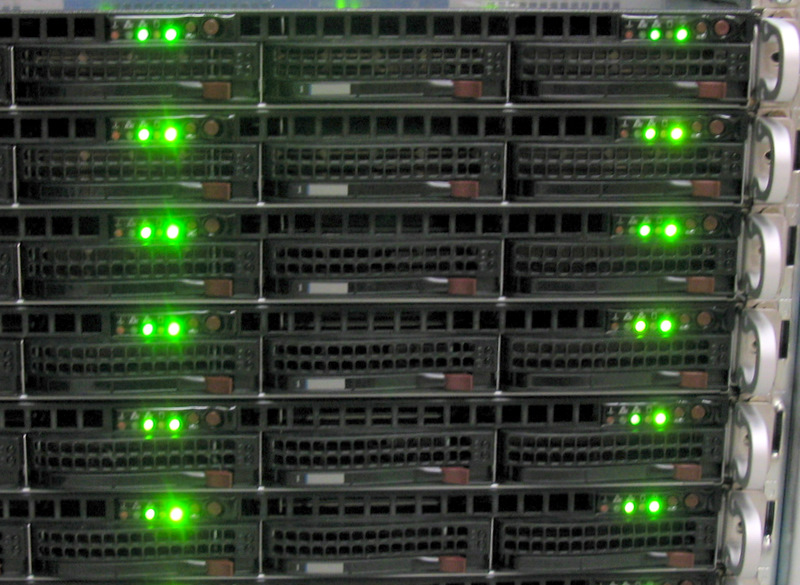
The Arizona Center for Mathematical Sciences (ACMS) is a recognized world leader in the study of linear and nonlinear optical interactions. The ACMS possesses a dedicated in-house supercomputing laboratory that provides high performance computing, storage, and visualization resources to its researchers.
ACMS Compute Servers
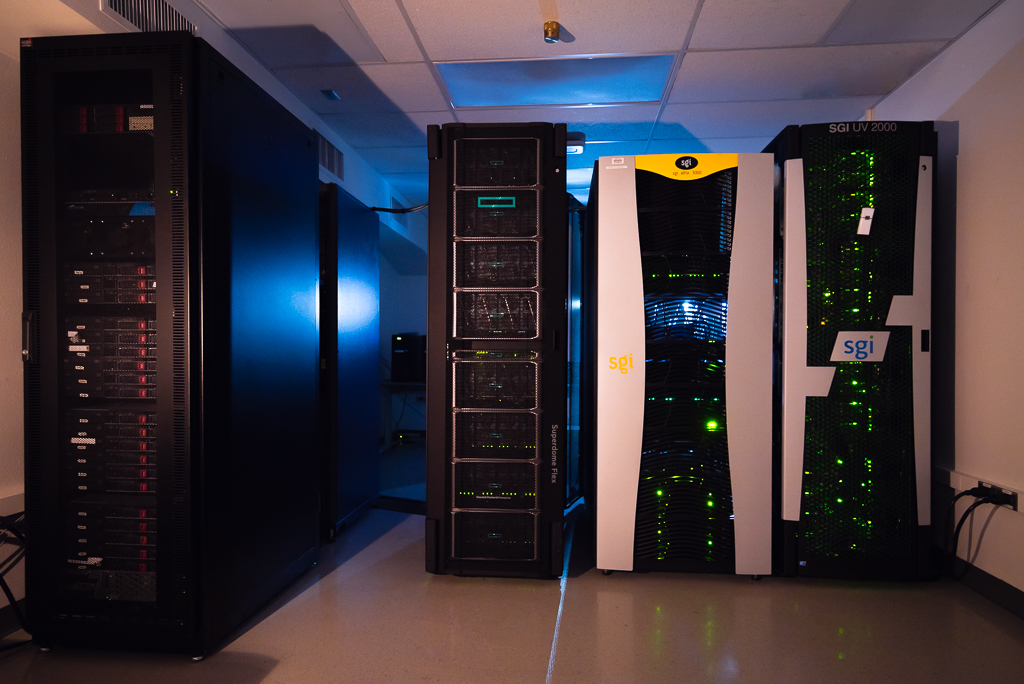
The ACMS operates three main compute servers housed in a dedicated on-site cooled server room (above). Our primary compute server is a 896 core Superdome Flex from Hewlett Packard Enterprise installed in November 2018.
Our secondary compute server is a 384 cores UV2000 from Silicon Graphics installed in January 2015.
Our third compute server is a 144 cores Altix XE cluster also from Silicon Graphics.
|
HPE Superdome Flex |
SGI UV2000 |
SGI cluster |
| Architecture |
Superdome Flex |
UV 2000 |
Altix XE |
| Processors |
Intel Xeon SP-8176 |
Intel Xeon E5-4617 |
Intel Xeon E5420 |
| Total # of Cores |
896 |
384 |
144 |
| Processor Speed |
3.8 GHz |
2.9 GHz |
2.5 GHz |
| Cache |
39 MB shared by 28 cores |
15 MB shared by 6 cores |
6 MB shared by 4 cores |
| Total Memory |
12 TBytes |
4 TBytes |
386 GBytes |
| Interconnect |
SGI NUMAlink 8 |
SGI NUMAlink 6 |
InfiniBand 4x DDR |
Researchers at the ACMS are also provided with high end custom built workstations (containing up to 44 cores and 384 GBytes memory per workstation) for software development, numerical simulations testing and data visualization.
Current computational projects at the ACMS encompass a broad range of numerical and computational techniques including but not limited to:
- Unidirectional Pulse Propagation Equation (UPPE) to model femtosecond wave packet propagation and filamentation using realistic optical modeling of the atmosphere for high power mid-IR laser filamentation over extended distances
- 3D vector Maxwell Finite Difference Time Domain (FDTD) to model nano-scale optical structures
- Density Functional Theory (DFT) to investigate the electronic structure of many-body systems in condensed matter
- Fully microscopic many-body models for the description of all material characteristics that are at the heart of VECSEL semiconductor laser design and operation
All projects typically require large computational resources in terms of memory and CPU. Often these codes exhibit non-local data access patterns making parallel implementation on shared memory architectures significantly simpler from a programming point of view.
The range and quality of the high performance computing facilities at the ACMS significantly reduce software development time and improve the performance of ACMS simulation software.
Compute Server Details
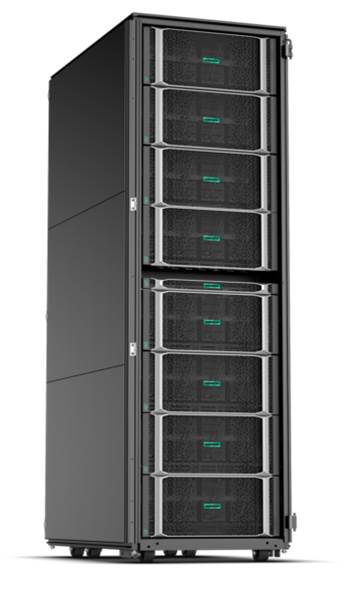
Our primary compute server is a Superdome Flex (left) from Hewlett Packard Enterprise. HPE purchased Silicon Graphics International (SGI) in 2016. The Superdome Flex is a direct continuation of the SGI UV2000 computer architecture. The Superdome Flex uses a new NUMALink8 interconnect and the latest Intel "Skylake" Xeon Scalable Platform processors released in the third quarter of 2017. This latest generation computer was installed at the ACMS in November 2018 and hosts 896 cores and 12 Terrabytes of main memory.
The Superdome Flex is scalable, cache coherent shared memory computer. It presents to users a programming interface similar to a single workstation (any program has access to all the cores and all the memory of the system); it is far less complex to program than traditional cluster systems with many distributed nodes. The ACMS Superdome Flex contains 32 Intel Xeon SP-8176 "Skylake" 28 core Processors at 3.8GHz for a total of 896 cores. It has 12 TBytes Main Memory and 48 TBytes of Fibre Channel connected fast disk storage.
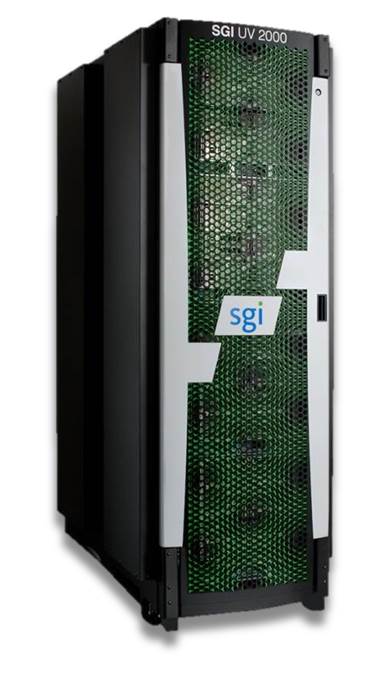
Our secondary compute server is a UV2000 from Silicon Graphics (right). This computer was installed at the ACMS in September 2012 and upgraded to 384 cores and 4 Terrabytes of main memory in January 2015. The SGI UV2000 is scalable, cache coherent shared memory computer. It presents to users a programming interface similar to a single workstation (any program has access to all the cores and all the memory of the system); it is far less complex to program than traditional cluster systems with many distributed nodes.
The ACMS UV2000 contains 64 Intel Xeon E5-4617 "Sandy Bridge" 6 core Processors at 2.9GHz for a total of 384 cores. Processors are connected in a 4D enhanced hypercube topology using SGI UV2 ASIC and 6th generation Numalink system interconnect. It has 4 TBytes Main Memory, 12 TBytes SAS fast disk storage and 16 TBytes attached storage. The system also integrates 8 nVidia M2090 GPUs each with 512 CUDA cores and 6 Gbytes of on board memory.
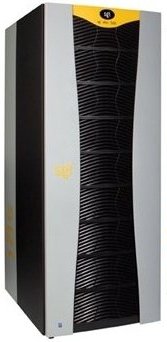
Our oldest compute server is a SGI Altix XE cluster from Silicon Graphics (left). This cluster contains 36 Intel Xeon E5420 Quad Core Processors for a total of 144 cores. Each processor supports a super-fast 1600 MHz front-side bus and the cluster has combined capacity of 368GBytes of FBDIMM memory. The cluster uses an InfiniBand interconnect that is optimized for high performance computing (HPC) applications.
Workstation Details
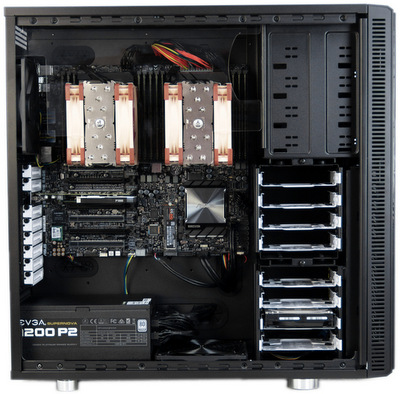
The ACMS also possess a number of custom built, ultra quiet, high performance workstations used for software development and testing, small scale simulation, post-processing and 3D visualization.
These air or water cooled workstations contain dual Intel's Xeon Scalable processors, with up to 44 cores and support up to 386GB of ECC memory offering tremendous performance potential.
Our newest workstations also contain 2TBytes of on board PCIe M.2 storage which provide write speeds as high as 3500MB/s i.e. up to 7x the write speed of SATA Solid State Drives (SSDs).
Most workstation are also equiped with nVidia GPUs capapable up to 1 teraflop of double precision performance.

VECSEL Modeling
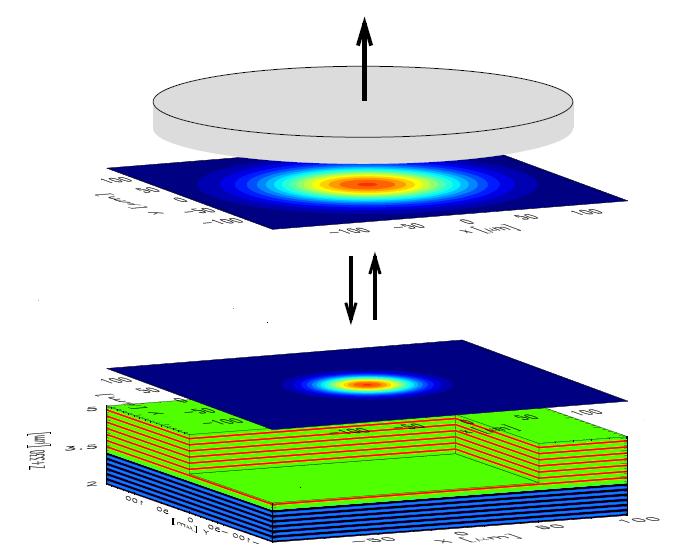
Modeling thermal properties of the optically pumped VECSEL requires solution of coupled PDEs, describing heat generation and transfer through the device, and carrier transport in the QWs, in at least two space dimensions. Accurate estimation of the temperature distribution in the active layer of the multi-QW VECSEL depends on the realistic model representation of the heat transport through the device substrate and the heat sink, which leads to computations with large number of spatial grid cells.
In addition, the carrier localization in the QWs necessitates small grid cell size in the active layer of the device, further increasing the computational problem size. The discretization of the equations leads to a large, sparse linear system of equations, suitable for solution using iterative solvers. The software developed for the simulation of the thermal properties of VECSELs is based on Aztec library - a massively parallel, iterative solver for sparse linear systems (available from Sandia National Lab).
Benchmark of the code for modeling thermal properties for problems with constant number of grid points per CPU, indicates better > 90% speedup on up to 16 CPUs. Comparison of the performances on systems with faster processors indicates that near linear improvement in computation time can be projected with the improved processor speed. Further development of the model will include addition of the effects of the optical field on the lasing properties of the VECSEL due to field dependence on the transverse coordinate. Numerical solution of the field equations representing this effects can take advantage of the parallel FFT libraries, optimized for shared memory architecture.
FDTD
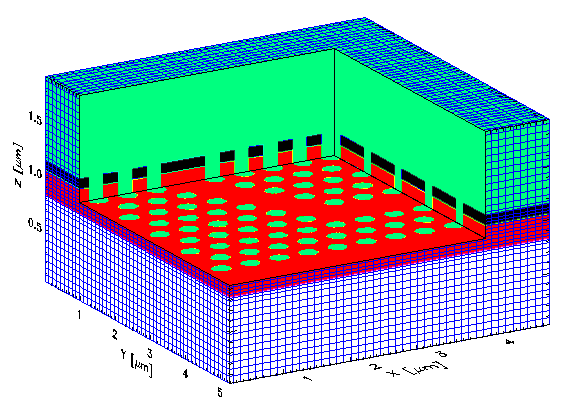 Simulation of the photonic components, with feature sizes on the scales comparable to the wavelength of light, requires full vector solution of the classical electrodynamics equations in 2- or 3-D.
One such problem is interaction of the focused laser beam with phase-change layer of the optical disk data storage system. Large domain size (20*lambda x 20*lambda) and number of points (800x800x100 cells, even with non-uniform grid resolving the region of the focused spot) lead to large memory requirement and long simulation times.
Two-three point time step storage typical for the models of the dispersive material properties in the time domain, limits the size of the problem that can addressed with the FDTD method. The memory limitation also becomes dominant for problems that require high resolution in the spatial frequency domain, requiring large computational domain size.
Due to scalability, the FDTD computations will benefit linearly from both the improved clock speed and nearly six times larger memory of the new system.
Adaptive Mesh Refinement FDTD
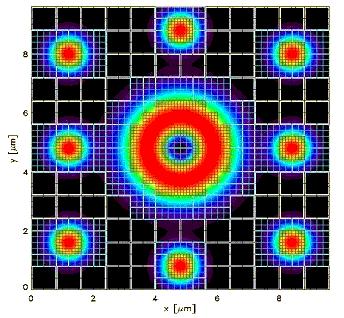
An alternative approach suitable for simulations involving large FDTD computational domains is to employ Adaptive Mesh Refinement (AMR).
AMR algorithms represent the computational domain as a set of nested, locally refined grids. The AMR approach can reduce the memory and computational requirements when compared to traditional uniform mesh discretization.
In AMR, cartesian grids are refined around fine-scale structures to increase the resolution of the solution and focus computational resources on the regions of interest. However, AMR algorithms present a number of parallel implementation issues, particularly on distributed memory architectures, not encountered in non-AMR implementations of FDTD method. The main implementation difficulties lie in representation and data management of the nested grid hierarchy, dynamic communication of data across grids at the same refinement level and between grids at different levels of refinement, and load balancing the distribution of refined grids across processors in order to minimize data communication and maximize processor utilization. Some, though not all of these implementation issues are simplified in a shared memory architectures.
Photonic crystal fibers
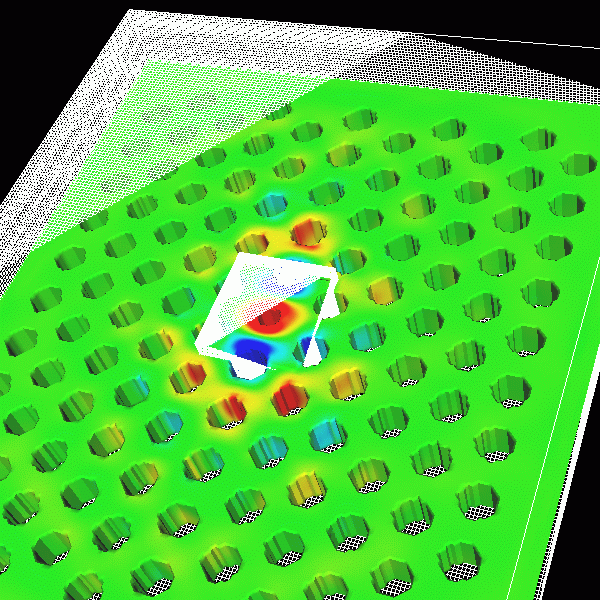
 Photonic crystal fibers (PCF) are complex structures with the potential to be used as single mode, large-core, compact high-power lasers. In order to simulate these structures with such complicated geometries, one needs to use the finite elements method (FEM).
It is possible to simulate only the overly simplified versions of the PCF on available high speed single processor machines. Any attempt to simulate the PCF in 3 dimensions or even complicated geometries in 2 dimensions requires much faster computation power along with significantly greater memory capacity.
In a complicated PCF structure, especially in 3-D, the FEM stiffness matrix is built on the whole domain of computation. For small scale problems, software libraries, such as ARPACK, can be used to diagonalize the FEM matrices and find the relevant eigenvalues and eigenvectors.
Some capabilities of the ARPACK software package, such as the ability to solve symmetric, non-symmetric, and generalized eigenproblems are of significant importance in our FEM simulations. For solving large scale eigenvalue problems, the matrices can become prohibitively large requiring efficient parallel matrix solvers. Matrices on the order of a few hundred thousand by a few hundred thousand are common.
In higher order FEM these matrices tend be less sparse and defeat the memory locality assumptions of many sparse matrix solvers. Efficient parallel matrix solvers are easier to implement on shared memory multiprocessors, tests of a parallel implementation of ARPACK on SGI machines show near 90% efficiency.
|